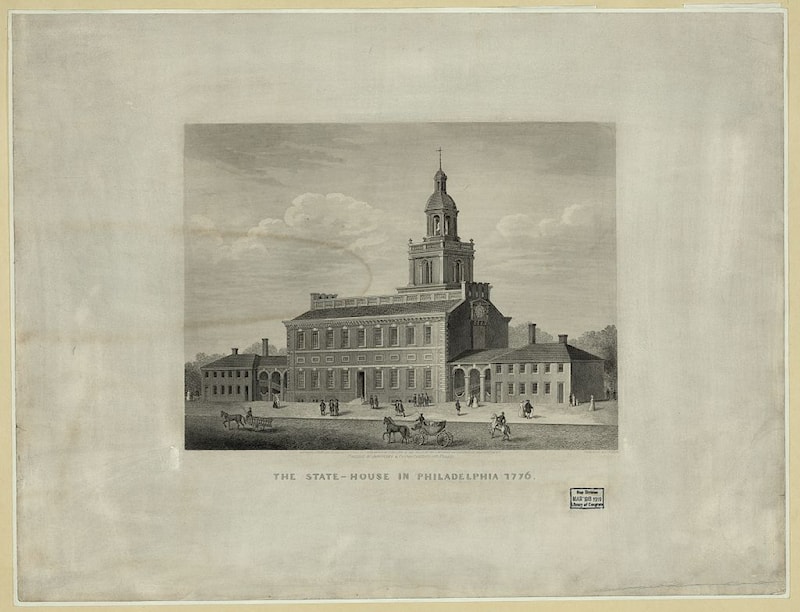
On Monday morning, September 9, 1776, the Second Continental Congress sat in the Pennsylvania State House in Philadelphia. The Revolutionary War was already under way. Outside, carts rattled past the brick front and the steeple. Inside, the journal that day looks almost ordinary: an advance of pay for an engineer in the northern army, half a million dollars for the army at New York, a committee to hear an appeal about a schooner called the Thistle.
Then came a short resolve.
That in all continental commissions, and other instruments, where heretofore the words "United Colonies" had been used, the stile be altered for the future to the "United States."
That was it. No parade. No long speech recorded in the journal. The clerks were told to stop writing one phrase and start writing another.
The words had been shifting for months. Thomas Jefferson's June draft of the Declaration of Independence opened with "the UNITED STATES OF AMERICA." The final Declaration of July 4 mixed "united States of America" with "United Colonies." Richard Henry Lee's June resolution had still spoken of "these United Colonies." On September 9, Congress made the change stick on paper that mattered: commissions and other continental instruments. From that Monday forward, the official style was the United States.
The same day, three members left Philadelphia on another errand. Benjamin Franklin, Edward Rutledge, and John Adams were bound for Staten Island to meet Lord Howe. Adams later wrote that Franklin and Rutledge rode in chairs and he went on horseback. The first night they lodged at an inn in New Brunswick. The taverns were so full that Franklin and Adams shared one small chamber and one bed. Adams shut the window against the night air. Franklin opened it again and began a lecture on colds and foul air until Adams fell asleep. They were riding out as ambassadors of a Congress that had just told its clerks to write "United States."
Howe would entertain them on moss and green sprigs laid over a dirty floor, with claret and cold ham, and still treat them only as private British subjects. They would come home with nothing settled. The name on the commissions, though, did not go back.
Our 2026 White House Heritage Collection ornament for the 250th anniversary is finished in 24 karat gold on brass, made in America, and ships with a history card.
See the 2026 250th Anniversary ornament. Collect the rest of the White House Heritage Collection.