On the morning of September 18, 1793, President George Washington crossed the Potomac with a company of Alexandria volunteer artillery. Brass bands met him on the far bank. Masons from Maryland and Virginia fell in beside him in full lodge dress. The first parade in the new Federal City formed at President’s Square, the muddy construction ground where James Hoban’s President’s House was rising, then marched about a mile and a half east to Jenkins Hill.
There, at the southeast corner of the planned Capitol, the procession stopped around a huge stone. Joseph Clark, Grand Master pro tem for Maryland, stood with Washington. So did Dr. E. C. Dick, master of Alexandria Lodge No. 22. An engraved silver plate, made in Georgetown by Quaker silversmith Caleb Bentley, was brought forward and its inscription read aloud. The plate named the day, the thirteenth year of American Independence, the first year of Washington’s second term, and the year of Masonry 5793. It named the District commissioners, Thomas Johnson, David Stuart, and Daniel Carroll. It named the architects James Hoban and Stephen Hallet. It named Collen Williamson, master mason.
Washington stepped down into the foundation trench people then called the cavazion. He set the silver plate on the ground and lowered the cornerstone onto it. Corn, wine, and oil consecrated the stone in the old Masonic way. Artillery volleys answered Clark’s oration. Afterward the crowd shared a barbecue from a five-hundred-pound ox. By dark the day was over.
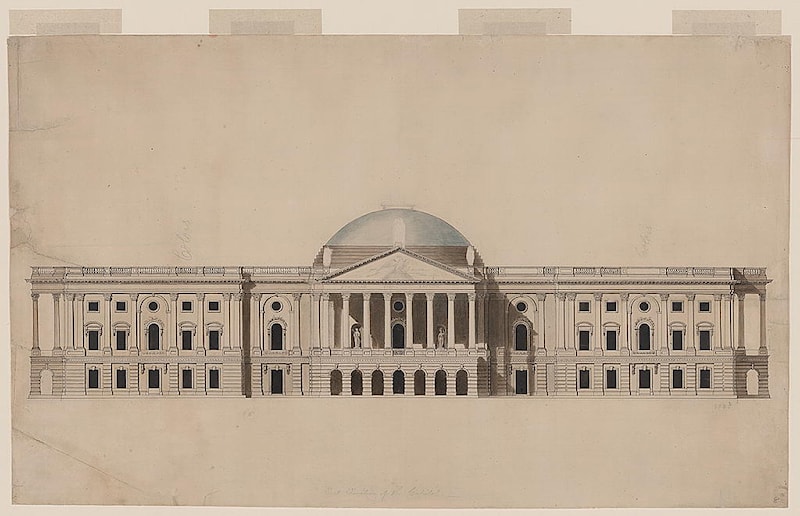
Months earlier Washington had already chosen the look of the building that would rise over that stone. On January 31, 1793, he wrote the District commissioners that Dr. William Thornton’s plan had the “Grandeur, Simplicity and Beauty” he wanted. The next day Thomas Jefferson told commissioner Daniel Carroll the same thing in plainer words: among the plan’s admirers, “no one is more decided than him whose decision is most important.” Jefferson called Thornton’s design “simple, noble, beautiful.” Congress funded the work. Washington came back from time to time to watch the walls go up. He died in December 1799, less than a year before the Senate and House first sat in the unfinished Capitol.
The silver plate has not been seen since that Wednesday. Architects of the Capitol have searched with metal detectors and soil tests; the exact corner is still argued. What remains clear is the route itself: from the unfinished President’s House to the unfinished Capitol, with Washington carrying the city’s future under one stone.
Our 2026 U.S. Capitol Marble Ornament, made with the U.S. Capitol Historical Society, puts a different piece of that building in your hand. At its center is an inlay cut from real Capitol marble removed during renovations in the mid-1990s. Beacon Design makes the piece in the United States. It ships ready to hang.
See the 2026 U.S. Capitol Marble Ornament.